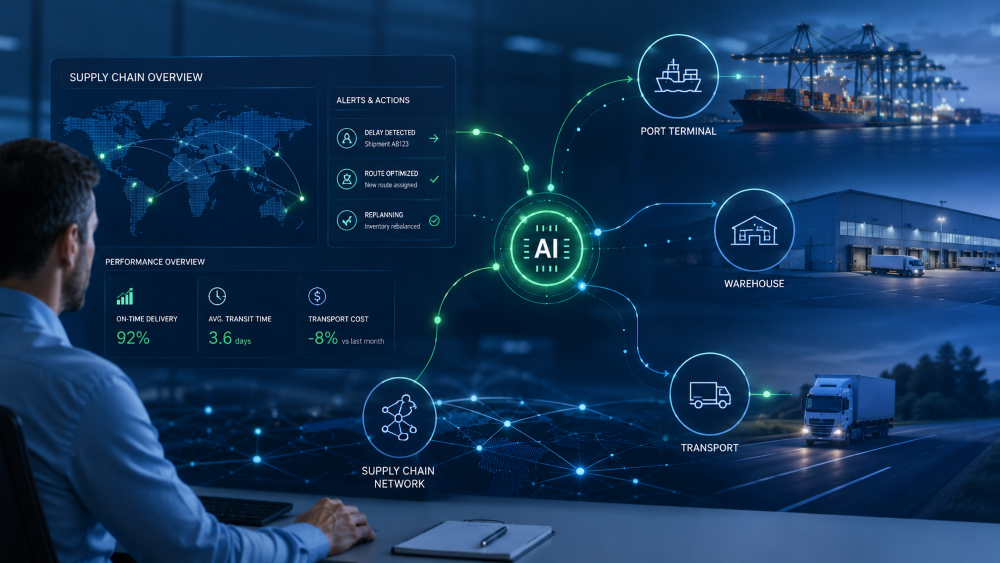
Agentic AI in transport and logistics: The shift to autonomous operations
Over the past few years, AI has evolved significantly within the transport and logistics sector. In an initial phase, its adoption was mainly focused on analytical capabilities: demand forecasting, estimated times of arrival (ETA), or operational performance analysis. However, the market has entered a new stage.
This change is driven by the emergence of Agentic AI systems, capable of generating recommendations and executing decisions within a defined framework, going beyond predictions. This represents a relevant evolution in the sense that artificial intelligence stops being a support for decision-making and instead becomes an operational and essential actor within processes. Logistics organizations that do not adopt agentic AI are falling behind.
Why is Agentic AI essential?
In the current context, marked by demand volatility, fragmented supply chains, and increasing regulatory pressure, organizations need to respond in real time to constant disruptions: delays, changes in commercial conditions, operational incidents, or cost variations. Traditional models, even predictive ones, are insufficient when speed of reaction becomes a critical factor.
This is where agentic systems begin to show their value. Instead of simply identifying a problem, they can evaluate alternatives, simulate scenarios, and execute actions autonomously. For example, in the event of a shipment delay, these systems can detect the issue, notify the customer, reorganize logistics planning, and even trigger a reshipment, all without direct human intervention.
“In the field of regulatory compliance, for example, it is already possible to rely on agents that consult real-time regulatory data, such as tariffs, restrictions, or import requirements, and generate actionable summaries.”
It does not stop at transport; this approach extends to multiple operational areas within supply chain. In the field of regulatory compliance, for example, it is already possible to rely on agents that consult real-time regulatory data, such as tariffs, restrictions, or import requirements, and generate actionable summaries instantly, reducing errors and risks associated with non-compliance. In IT operations, specialized agents can analyze logs in real time, prioritize incidents and generate actionable alerts, accelerating problem resolution and minimizing disruptions.
Likewise, these systems are transforming internal processes. The automation of intake workflows allows the classification of requests, extraction of relevant information and routing of tasks without friction. At the same time, the ability to analyze large volumes of information facilitates knowledge discovery, connecting dispersed data and generating useful insights for decision-making. Even traditional administrative functions, such as appointment management or employee onboarding, can be orchestrated through multiple agents that coordinate tasks autonomously.
Some challenges related to Agentic AI ahead
However, despite its potential, the adoption of Agentic AI poses significant challenges. Because everyone is talking about agentic AI, but how should it be approached in practice?
There are three main market challenges that all companies are facing and that must be overcome to learn, evolve and gain competitiveness:
- Agents that target simple and repetitive operations in a simple environment may not find complexity in the integration process. However, as organizations expand toward more advanced, enterprise-wide capabilities, a robust architecture built on interoperability, event-driven design and strong data governance, becomes more important to unlock full value. Without this adequate architecture, the impact remains limited to isolated use cases.
- Building trust is also a big challenge as delegating operational decisions to autonomous systems implies redefining control and supervision models. This should be then done with small steps, from the inside to the outside. One AI implementation after another will bring the trust needed to develop complex operations, always with human validation as a main pillar.
- The third big challenge is organizational. The adoption of Agentic AI represents a shift in the way of working. It implies redesigning processes, redefining roles and preparing teams to interact with systems that evolve continuously. In this context, the human factor does not disappear, but shifts towards supervision of functions, exception management and strategic decision-making. It is about amplifying efficiency and outputs with the same number of human resources.
How to overcome these obstacles to make Agentic AI do what it should do
“A proven approach is to adopt a hybrid model, where autonomous systems operate alongside human supervision.”
The first step is to understand where a company currently stands and define clear objectives, as the range of AI possibilities is extensive. Setting priorities should balance long-term, strategic ambitions with practical, near-term opportunities, combining larger, more complex AI goals with simpler solutions that address specific operational challenges and deliver immediate value. This enables the creation of a personalized and scalable roadmap. A proven approach is to adopt a hybrid model, where autonomous systems operate alongside human supervision. In this way, organizations combine execution speed with oversight, allowing operations to scale while maintaining control over critical aspects such as regulatory compliance, risk management and relationships with customers and partners.
The development of Agentic AI marks a turning point in the sector, since, in addition to improving existing processes, it involves redefining how decisions are made and executed. As these capabilities mature, competitive advantage will not only come from having artificial intelligence, but from the ability to integrate it coherently within the operating model.
This change is inevitable; the real question is how to take the step in a way that delivers sustainable value aligned with business objectives.